
Viruses getting on your nerves?
While that may be the case, in the literal sense I most certainly hope not!
Yup, I’m talking about viruses that can literally get on (and into) our nerve cells. Nerve cells, or neurons, are those special electrical cells throughout your body that allow you to sense things – sight, sound, touch, smell, and taste – and that make up your brain, enabling more complex behaviors like thinking, remembering, loving, and learning. Needless to say, we don’t want these viral invaders getting anywhere near our nerves!
So now to the question on everyone’s mind: can SARS-Cov-2, the virus that causes COVID-19, do this? The answer is cautious and complicated, yes.
Many of you are probably now familiar with these two bizarre terms – anosmia and ageusia. What’s even more bizarre, is that anosmia (loss of smell) and ageusia (loss of taste) are common early symptoms of COVID-19. Did this strike you as odd? Why is this respiratory virus that attacks our lungs, suddenly making us unable to smell our fresh cup of coffee in the morning or making our scrambled eggs taste like cardboard? It’s puzzling…
Adding to this puzzle, doctors have recently reported that a large percentage of COVID-19 patients are experiencing neurological complications that can only be attributed to the brain itself, the central hub of all your neurons. These complications range from headaches to stroke. And this is where it starts to get really concerning.
But before we proceed, let’s review what we already know about COVID-19 and SARS-CoV-2, as it relates to the brain just to make sure we’re all on the same page.
SARS-CoV-2 is the virus that causes the disease COVID-19.
SARS-CoV-2, the virus, likes to hang out in our nose. (This is why we do nasal swabs to test active infection)
A common early symptom of COVID-19 is a loss of smell and taste.
The brain itself is affected in some cases of COVID-19, which suggests that the virus is likely damaging neurons in our nose – and potentially even damaging the neurons in our brain too.
This brings us to the next looming question – how exactly is SARS-CoV-2 affecting the brain? As it stands, the field seems to be split between two possible explanations:
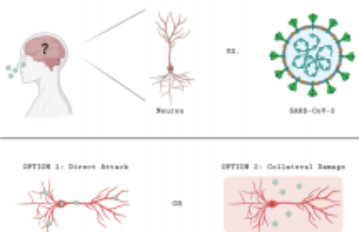
Option 1: Direct Attack
Picture yourself as a little neuron-like the one in the drawing above. You live in the nose and it’s your full-time job to process smells! One day you see a fire. You guessed it – the fire represents the virus! Fortunately, it looks like a small fire. You try to remain calm as you watch a security cell (immune cell) grab a fire extinguisher and go to put the fire out. Depending on the size and type of the fire, this will either put the fire out, or it will continue to grow, and you risk getting burned. If too many neurons get ‘burned’ by the virus, they won’t be able to do their jobs – causing altered or complete loss of our sense of smell!
Option 2: Collateral Damage
This time you see a fire, but it looks way bigger. You know a fire extinguisher won’t help and you see a security cell run to pull the nearest fire alarm. At the time, this seemed like the right call – but the security cell forgot that the building isn’t up to modern safety code and there aren’t enough fire escape doors! Panicked, the security cells try to help more by yelling out instructions, but this ends up causing a stampede! The sturdier cells escape quickly, but the delicate neurons get trampled. Despite not getting near the fire itself, the neurons tragically still suffer collateral damage amidst the chaos.
Even though scientists and doctors are working hard to answer these questions, we don’t have enough information to make any conclusions right now. But if you are wondering how many people here in Washington State have experienced neurological complications and which symptoms to look out for – keep an eye out for the results of our study!
Victoria Rachleff is a Molecular & Cellular Biology Ph.D. student at the University of Washington. Melding her background in neuroscience and interest in virology, Rachleff uses clinical data and animal models to study viruses that infect the nervous system.