
The Mysterious Marbled Murrelet
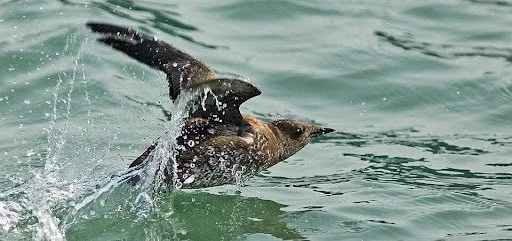
A marbled murrelet in its summer breeding plumage of browns and white feathers flying out of the water of the Pacific coast. The muddle coloration is what gives this bird its name. Photo by Kim Nelson and Dan Cushing, 2020
If I asked you to pick an animal that represents the Pacific Northwest, what would you choose? The majestic gray wolf? Once removed from the region, is now recolonizing and thriving in parts of Washington, Oregon, and slowly in California. The killer whale? Its striking black and white color breaching from the moody and gray Pacific Ocean.
Maybe you’d vote Bigfoot?
But what if I told you there was a species that dwells in the Pacific, relying on the California Current to feed and breed, but also requires old-growth forest to nest and rear young, and while not a cryptid, it is cryptic.
The marbled murrelet is a small seabird species that forages along the coastline of the Pacific Northwest, and like the killer whale, it sports a stark black and white plumage throughout most of the year. However, unlike other seabird species that nest along beaches and cliffs, the marbled murrelet flies deep into the woods to nest on large, mossy branches of old-growth firs. The journey from sea to tree is a marathon; these birds fly up to 77 miles inland to find the right branch [1]. To stay hidden, they trade their bright black and white feathers for a mottled blend of milk-chocolates that give them their name which allows them to camouflage perfectly into the trees.
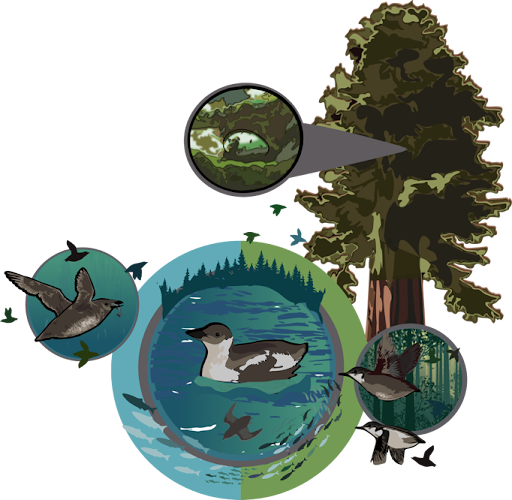
Because of loss of nesting habitat from logging, marbled murrelets were listed as federally threatened under the Endangered Species Act in the United States in the early 90s and while considerable efforts have been made to improve nesting habitat, the species has continued to decline in Washington. That’s because the old-growth canopy is only half of their home. While we work to protect the mossy branches where they raise their young, the Pacific Ocean they call home is changing. Warming waters and shifting currents are destabilizing the food web, making the journey from sea to tree increasingly difficult. In the Puget Sound, the silence is growing. Recent estimates show significant declines in murrelet density throughout most of the year, yet the exact cause of this specific regional vanishing act remains unknown [2].
The mystery of the marbled murrelet was its shield for centuries, keeping its nesting secrets safe from human eyes. But today, that same elusiveness is its greatest threat. It is hard to rally a public to save a bird they have never seen: a bird that looks like a shadow on the water and a knot on a tree branch.
As the ocean warms and their numbers continue to decline, the murrelet challenges us to care about the invisible. It isn't just that the water is warming; the marbled murrelet has been identified as the most climate-sensitive bird species in the northwest [3]. When marine habitat quality drops, the birds may abandon even the most pristine nesting sites, proving that a protected forest is only half a home. We must protect the complexity of the California Current just as fiercely as we protect the majesty of the old-growth forest. Because in the end, the Pacific Northwest isn't defined by its most famous icons, but by its most fragile ones. The marbled murrelet is telling us that the sea and the forest are one. Right now, that connection is fraying.
References
Lorenz, T. J., Raphael, M. G., Bloxton, T. D., & Cunningham, P. G. (2017). Low breeding propensity and wide‐ranging movements by marbled murrelets in Washington. The Journal of Wildlife Management, 81(2), 306-321. https://doi.org/10.1002/jwmg.21192
Pearson, S. F., Keren, I., Lance, M. M., & Raphael, M. G. (2024). Correction: Non-breeding changes in at-sea distribution and abundance of the threatened marbled murrelet (Brachyramphus marmoratus) in a portion of its range exhibiting long-term breeding season declines. PloS one, 19(9), e0310567. https://doi.org/10.1371/journal.pone.0310567
Case, M. J., Lawler, J. J., & Tomasevic, J. A. (2015). Relative sensitivity to climate change of species in northwestern North America. Biological Conservation, 187, 127-133. https://doi.org/10.1016/j.biocon.2015.04.013
Sierra Gillman is a PhD candidate in the Quantitative Ecology Lab in the School of Environmental and Forest Sciences at the University of Washington. Her research applies quantitative models to improve long-term conservation efforts for marine birds and mammals throughout the Pacific Northwest.