
The Coriolis Effect
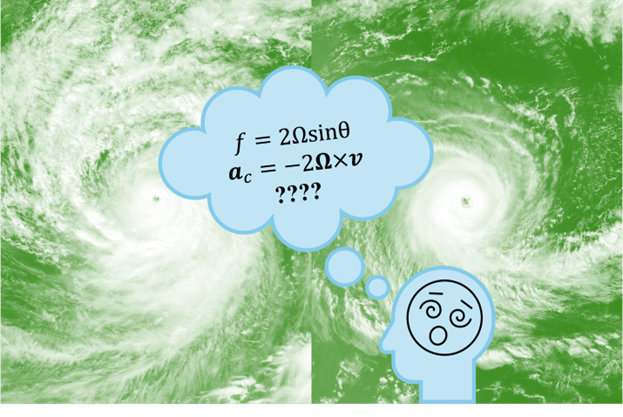
My office is filled with the detritus of grad students past. Along with long-forgotten posters, empty filing cabinets, and (mysteriously) a hard hat, there’s an old physics textbook. I have no idea who it originally belonged to, but it’s been here since the day I moved into my desk and all 1,100 hardcover-bound pages have haunted my peripheral vision ever since. The moment I had the idea for this article, I immediately pulled that book from its dusty shelf and flipped through the first few chapters, though I already knew I was going to be disappointed by what I found.
I have a grievance with the way students are taught a particular physics topic: the fingerprint that Earth’s rotation leaves behind on motion, known as the Coriolis effect. We’re often taught that the Coriolis effect is a complex fringe case with few practical applications. In reality, Coriolis is quite intuitive and its impacts touch all people on Earth.
To build that intuition, first imagine you’re walking along the inside of a train. You can move comfortably as long as the train is moving at a constant rate, but once the train speeds up, you’ll stumble. The speed of the train doesn’t push you around, but its acceleration does.
Like a person walking on a train, we live on a moving surface: the Earth, which is constantly rotating around its axis like a vinyl record on a turntable. When something rotates, it’s perpetually accelerating. The Coriolis effect is the result of this acceleration.
Over many decades, physicists have converged on one specific method for explaining Coriolis. Sure enough, it made an appearance in my old physics textbook, as it does in modern books. It usually goes something like this:
The Coriolis effect isn’t a force, but let’s call it a fictitious/apparent force anyway.
Coriolis deflects things clockwise in the northern hemisphere and counterclockwise in the southern hemisphere. (Just don’t ask why!)
This is only useful for when you want to fire a missile to a different latitude.
Was that confusing? When I was a physics student, I certainly thought so. But I eventually became an oceanographer and along the way braved courses like “Geophysical Fluid Dynamics”, where we really got into how Coriolis works. I’ll spare you the calculus, but I’m here to share that there’s a better way to teach this topic.
It starts with choice of language. There are good reasons to clarify why Coriolis isn’t a force in an introductory physics class, but words like "fictitious" and “apparent” needlessly confuse a non-expert audience.
Next, students should never need to memorize that Coriolis “switches directions” between the northern and southern hemispheres. The Coriolis effect turns objects in the same direction as Earth’s rotation. This is easily demonstrated! Find a prop, like a water bottle.
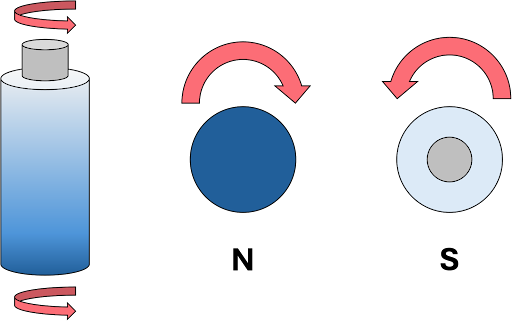
A demonstration of the Coriolis effect using a water bottle. This provides more physical understanding of how Coriolis changes the trajectory of motion than the typical rote memorization encouraged by most physics curriculums.
Hold it upright and spin it like a vinyl record “to the east” (to the right). Now, lift the bottle and look up at the bottom as though you’re in Earth’s northern hemisphere looking up at the north pole. It will be spinning clockwise. Repeat this for the southern hemisphere, except look down at the top. It will be spinning counterclockwise.
Finally, replace ballistics examples with any of the many fascinating environmental phenomena where Coriolis is extremely relevant, like ocean circulation and hurricanes. Pressure systems provide a great example of how Coriolis affects our everyday lives.
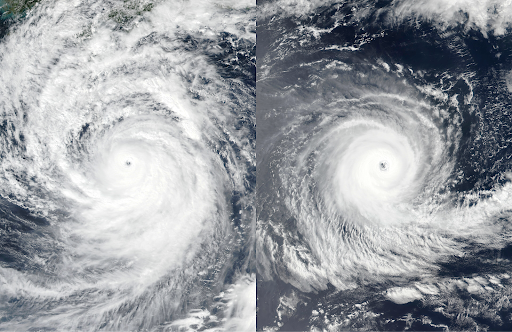
Satellite photographs of two hurricanes that occurred on different sides of the equator. Can you tell which hemisphere each storm happened in? [Answers: left - Typhoon Nanmadol in the northern hemisphere, right - Cyclone Darian in the southern hemisphere] (Source: NASA Worldview)
What will future dusty old physics textbooks say about Coriolis? We could continue to confuse students for the sake of tradition, but I think it’s time for us physicists to change our ways.
Emma Modrick is an oceanography graduate student studying the physics of the surface ocean using a combination of theory, simulations, and observations.. Her free time is consumed by desperate efforts to foil her cat's attempts at shredding all the paper in her home.