
Coral recruitment? In this economy? : Caribbean coral collapse, and the case for radical intervention
Timeseries of Craysfort Reef, located in the upper Florida Keys. Formerly abundant Elkhorn coral is now largely dead rubble, overgrown with macroalgae and eroded by boring sponges and invertebrates. Photos courtesy of Phil Dustan and colleagues, via the Biosphere Foundation
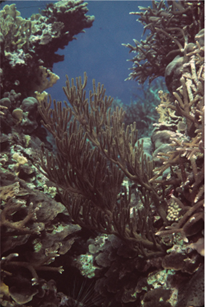
You’ve probably seen pictures like this before. It shows a beautiful, healthy reef in Discovery Bay, Jamaica. Maybe this is what you think of when you envision the perfect Caribbean vacation! There’s just one problem — this type of reef no longer exists.
Caribbean reef ecosystems collapsed before the first iPhone — and most people didn’t notice. This picture was taken in the 1970s, just before Caribbean corals were thrown into steep decline. While these reefs have yet to recover, a radical proposal could offer a second chance from halfway around the globe.
Historically, Caribbean reefs were dominated by two branching corals, Elkhorn coral (Acropora palmata) and Staghorn coral (Acropora cervicornus), which were responsible for constructing the complex, three-dimensional reef “framework” that supports a wealth of other species. While many Caribbean corals grow in boulder-like “mounding” formations, building the reef’s foundations, only Elkhorn and Staghorn can create its intricate structure. In the 1970s you could find huge thickets of Elkhorn and Staghorn coral. But in the 1980s, an ecological bomb went off. Actually, several bombs.
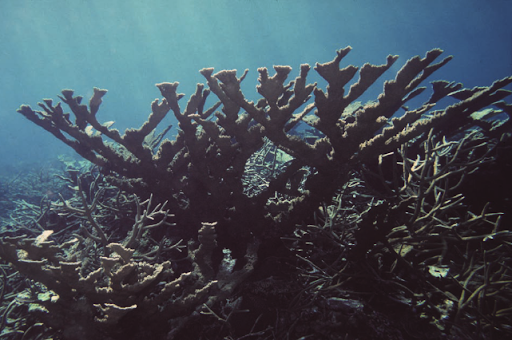
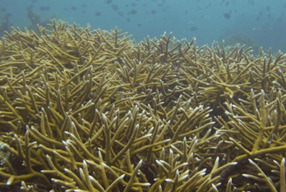
Elkhorn (left) and Staghorn (right) corals. Photos courtesy of William Sacco (Sacco 2023) and NOAA Fisheries, respectively.
Timeline:
pre-1980: Decades of industrialized fishing led to removal of herbivorous fish that kept macroalgae, a coral competitor, in check. This removed a line of defense for healthy reefs.
1980: The first bomb goes off. A devastating coral disease (“white band disease”) emerges, targeting Elkhorn and Staghorn corals, and their populations begin to plummet (Antonius A. 1981).
1983: The second bomb blows. Another waterborne pathogen emerges, killing 98% of the Caribbean’s long-spined sea urchins, one of the last remaining algal grazers (Lessios et al. 1984). Suddenly, there’s nothing preventing unchecked algae growth, and macroalgae begins to smother reefs.
1990s - 2020s: An endless series of smaller explosions as climate change starts to hit the Caribbean hard. We begin seeing mass bleaching events, in which high water temperatures stress or kill corals. Major events strike in 1987, 1990, 1997, 1998, 2005, 2014, 2015, 2022, and most recently in 2023 (Manzello et al. 2025).
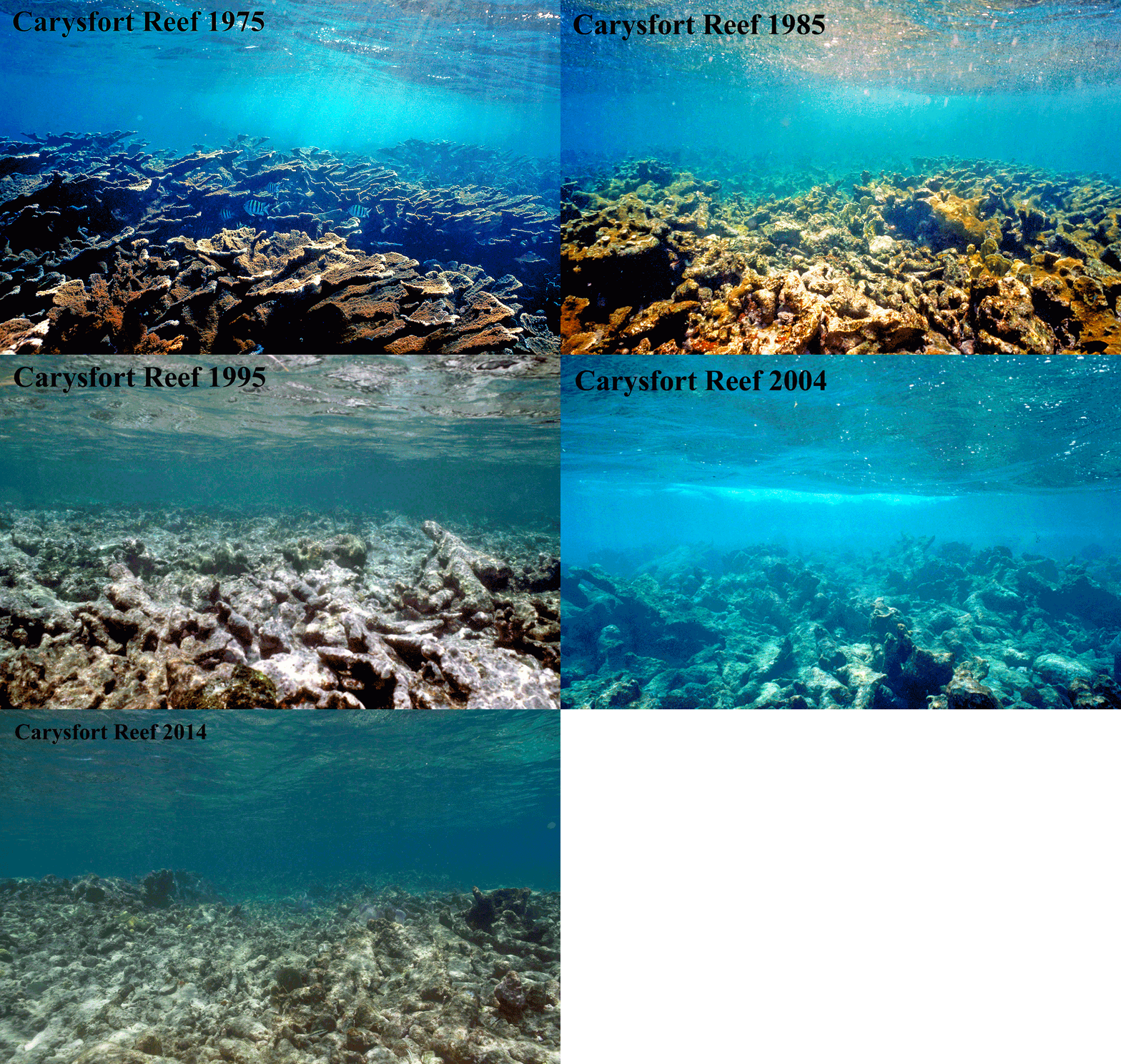
Timeseries of Craysfort Reef, located in the upper Florida Keys. Formerly abundant Elkhorn coral is now largely dead rubble, overgrown with macroalgae and eroded by boring sponges and invertebrates. Photos courtesy of Phil Dustan and colleagues, via the Biosphere Foundation
Today, these effects have compounded. Following major losses in the 1980s, Elkhorn and Staghorn populations never recovered. Recruitment (the settlement and growth of new coral larvae) has been increasingly stunted by macroalgae growth, bleaching stress, and invasive competition. On top of that, these species often reproduce asexually to create swaths of genetically identical clones, and have consequently lost a huge amount of genetic diversity. Elkhorn and Staghorn coral have now been declared functionally extinct in the Florida Caribbean (Manzello et al. 2025), with other regions at risk.
The realization that Elkhorn and Staghorn may be beyond saving has prompted some scientists to propose a radical intervention: deliberately introducing coral species from the Indo-Pacific to fill the Caribbean acroporids’ ecological role (Camacho et al., 2026). The Indo-Pacific is home to an incredibly diverse suite of coral species, including several with similar growth structures to Elkhorn and Staghorn. Critically, Indo-Pacific corals tend to be much better at successful reproduction and recruitment (some have even been termed “superrecruiters”), meaning they could have a much better shot at rebuilding degraded Caribbean reefs (Camacho et al. 2026).
Don’t get me wrong, this is hugely controversial. Introducing a foreign species has the potential for many unintended consequences: it could overrun other coral species, or introduce “hitchhiker” organisms or diseases. However, some scientists argue that the Caribbean is already decimated by invasives and disease — what’s a couple more? Without some kind of radical intervention, the complex reef habitats upon which countless species depend will be lost for good. While this proposal is highly-controversial, and faces many cross-country policy barriers, it may be the only path to restoring Caribbean reefs to something resembling their former glory.
References:
Acosta-Chaparro, Andrés Felipe, Esteban Agudo-Adriani, Gabriela Aguilera Pérez, et al. 2025. Status and Trends of Caribbean Coral Reefs: 1970 – 2024. GCRMN-Caribbean-1970-2024. Edited by Jérémy Wicquart, Laëtitia Mathon, Auriane Petit, Andrea Rivera-Sosa, and Melanie McField. Global Coral Reef Monitoring Network (GCRMN) and International Coral Reef Initiative (ICRI). https://doi.org/10.59387/BDHF9180.
Kathleen Durkin is a PhD student in Aquatic and Fishery Sciences who is broadly interested in how important marine organisms respond to environmental stress under climate change. Her current research involves studying stress response through the lens of epigenetics -- molecular features that can affect the body without altering the underlying DNA.